Best Cutlery for Disabled Hands: Easy-Grip Adaptives for Tremors and Arthritis
Answering the search intent for accessible dining, these select adaptive utensils are designed to reduce strain and improve control for people with arthritis, tremors, Parkinson’s, or limited hand strength. The top picks emphasize built-up handles, bendable or angled designs, and weighted options to minimize slipping and fatigue. Best for seniors, caregivers, and individuals managing hand difficulty, these sets help with daily meals and independence. The following 5 products are chosen for clarity, variety, and practical grip support.
| Product | Best For | Key Benefit |
|---|---|---|
| Bendable Adaptive Utensils for Elderly | Arthritis or tremors | Non-slip handles with bendable design |
| Adaptive Utensils 4 Pcs Set | Multiple grip positions | Wide grip, bendable for preferred position |
| 4-Piece Adaptive Utensils Set – 42° Angled | Parkinson’s or tremors | Angled, weighted for steadier control |
| 4-Piece Adaptive Utensils With Rocker Knife | Right-handed users | 42° angled with weighted grip |
| Nourislif Adaptive Utensils 4pcs | Seniors and elderly | 2.5 oz weight with built-up handles |
Bendable Adaptive Utensils For Elderly

Best For: Arthritis with a need for a bendable, non-slip grip. Why this selection: The utensils feature bendable heads and built-up handles to reduce grip effort and stabilize movements during meals.
Caution: Bent positions should be adjusted gently to avoid bending beyond comfortable limits that could cause user strain.
Adaptive Utensils 4 Pcs Set
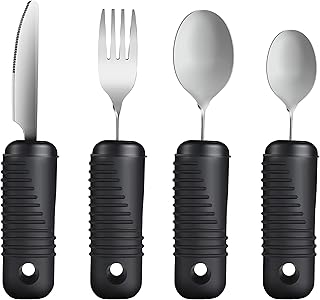
- Includes bendable fork, tablespoon, teaspoon, and dinner knife.
- Wide grip handles designed for arthritis and tremors.
- Teaspoon, tablespoon, and fork bend to user’s preferred position; knife fits both hands.
Best For: Users who want a compact, versatile set with bendable functionality. Why: It covers all four main utensils in one affordable package, enabling multiple grip positions for better control.
Caution: Left-handed users may have limited customization for the knife fit.
4-Piece Adaptive Utensils Set – 42° Angled

Best For: Parkinson’s or tremor management with extra angle and weight. Why: The angled design reduces wrist strain and provides steadier food intake.
Caution: Weighting can feel noticeable for small hands; ensure the weight is comfortable during use.
Rocker Knife & Shovel Spoon Set

Best For: Right-handed users seeking a complete set with a rocker knife for easier cutting. Why: The white-weighted design and 42° angle help steady cutting with less wrist movement.
Caution: The rocker knife requires some practice to optimize motion and avoid over-cutting.
Nourislif Adaptive Utensils 4pcs

- 4 pieces with built-up handles; weight around 2.5 oz each.
- Silverware set designed for seniors with arthritis or Parkinson’s.
Best For: Seniors seeking a lightweight, easy-to-grip set with built-up handles. Why: The 2.5 oz weight provides comfortable control without excessive heft, aiding stability during meals.
Caution: For users needing significantly heavier weight, consider alternatives with more weight or support features.
Buying Guide
Key purchase considerations help determine the best cutlery for disabled hands. Assess grip style, hand dominance, and daily meal routines to pick the most suitable set.
- Grip design: Built-up handles, non-slip surfaces, and bendable joints reduce the need for strong pinching.
- Angles and weights: Angled or weighted utensils offer steadier control for tremors and arthritis, but can feel different to use. Try a flexible bend or light weight first.
- Left vs right-handed use: Some sets are optimized for right-handed use; if you are left-handed, look for ambidextrous designs or handles that fit both grips.
- Cleaning and materials: Look for dishwasher-safe materials and easy-to-clean finishes to maintain hygiene with minimal effort.
- Durability and price: Budget options exist; prioritize sets with metal cores or sturdy plastic handles for longevity.
Frequently Asked Questions
- What makes adaptive utensils better for disabled hands?
- Do these utensils work for left-handed users?
- Are bendable utensils durable for daily use?
- Is it necessary to have weighted utensils?
- How should I clean adaptive utensils?
- Can these utensils be used by children?
They provide built-up handles, weight, or angle features that reduce strain and improve control during meals.
Some designs are ambidextrous, but many are right-handed specific. Check product details before purchasing.
Yes, but avoid bending beyond recommended limits to maintain the integrity of joints and handles.
Weighted utensils help stabilize tremors and provide a steadier bite, which can be beneficial for Parkinson’s or severe arthritis.
Prefer dishwasher-safe options or hand-wash with mild soap unless the product specifies otherwise.
Most are designed for adults; check size and weight to ensure safe use for children.