Prep & Kitchen Skills / THE HANDBOOK
Why Grams and Cups Are Not Interchangeable in Baking
Practical guidance · Check your own equipment, recipe and care instructions.
Grams describe mass, while cups describe volume. You cannot exchange one for the other without knowing the ingredient and the measurement convention, which is why a cup of flour and a cup of syrup should not become the same number of grams in a baking recipe.
Use the recipe’s own weights when it provides them. If it does not, choose an ingredient-specific reference and keep the limits of that conversion visible in your notes.
Separate the unit from the ingredient
A cup tells you how much space an ingredient occupies under a particular measuring method. A gram tells you how much mass the scale is measuring, regardless of whether the ingredient is fluffy, compact, granular, or liquid.
That difference becomes obvious when you compare a cup of loosely filled flour with a cup of water. The containers may occupy the same nominal volume while their contents have different masses.
Do not turn that example into a water-based conversion for every ingredient. The ingredient’s composition, preparation, packing, and the reference used can all matter to the relationship.
Also check which cup convention a recipe uses. A recipe written for a different market may not use the same volume convention you assume from a US measuring set.
Understand why flour exposes the problem
Flour can settle, compact, and trap air in different ways. Scooping directly into a bag and spooning flour into a cup do not necessarily produce the same amount, even when you level the top afterward.
King Arthur Baking’s recipe guidance uses 120 grams for one cup of its all-purpose flour. That is a stated recipe convention, not a universal promise for every flour, every brand, or every way of filling a cup.
If you follow one of that publisher’s recipes by weight, use the weight listed in the recipe. Do not replace it with a different chart because another source gives a number that looks more familiar.
If you follow an older handwritten recipe that only lists cups, preserve the original method as far as you can establish it. Converting the quantity can be useful, but the conversion cannot recover an undocumented measuring habit with certainty.

Read the entire unit label
Ounces can refer to weight, while fluid ounces refer to volume. A digital scale’s unit options may include several labels, so check the manual instead of assuming that every display mode measures a new physical property.
A mode labeled for liquid volume may calculate a result using an assumed relationship between mass and volume. That does not turn the scale into a universal volume instrument for oils, syrups, and all other liquids.
Likewise, a kitchen measuring jug may carry both metric volume marks and US cup marks. Those markings help you read volume; they do not provide the ingredient-specific mass you would need for an arbitrary conversion to grams.
Keep the original label attached when you copy a recipe into your notes. Writing only eight ounces after removing the word fluid can introduce a mistake before you even open the flour container.
Let one recipe govern one batch
Choose either the recipe’s supplied weight quantities or its volume quantities as a consistent starting approach. Avoid switching between unrelated charts for individual ingredients just because one conversion appears convenient.
When a recipe lists both systems, remember that its author may have rounded the displayed values. Small differences between a chart and the recipe do not automatically show that the recipe contains an error.
King Arthur’s ingredient chart explicitly notes that its chart and individual recipes may show differences. That supports using the recipe’s own instructions first rather than treating a general chart as an override.
If a quantity looks implausible, stop and check the original source before proceeding. A transcription error, a different ingredient form, or an omitted unit can be more important than the debate between cups and grams.
Write any deliberate change separately so you can evaluate it after baking. A successful adaptation is useful, but it should not silently become a claim about the author’s original formula.
Use a scale without adding new confusion
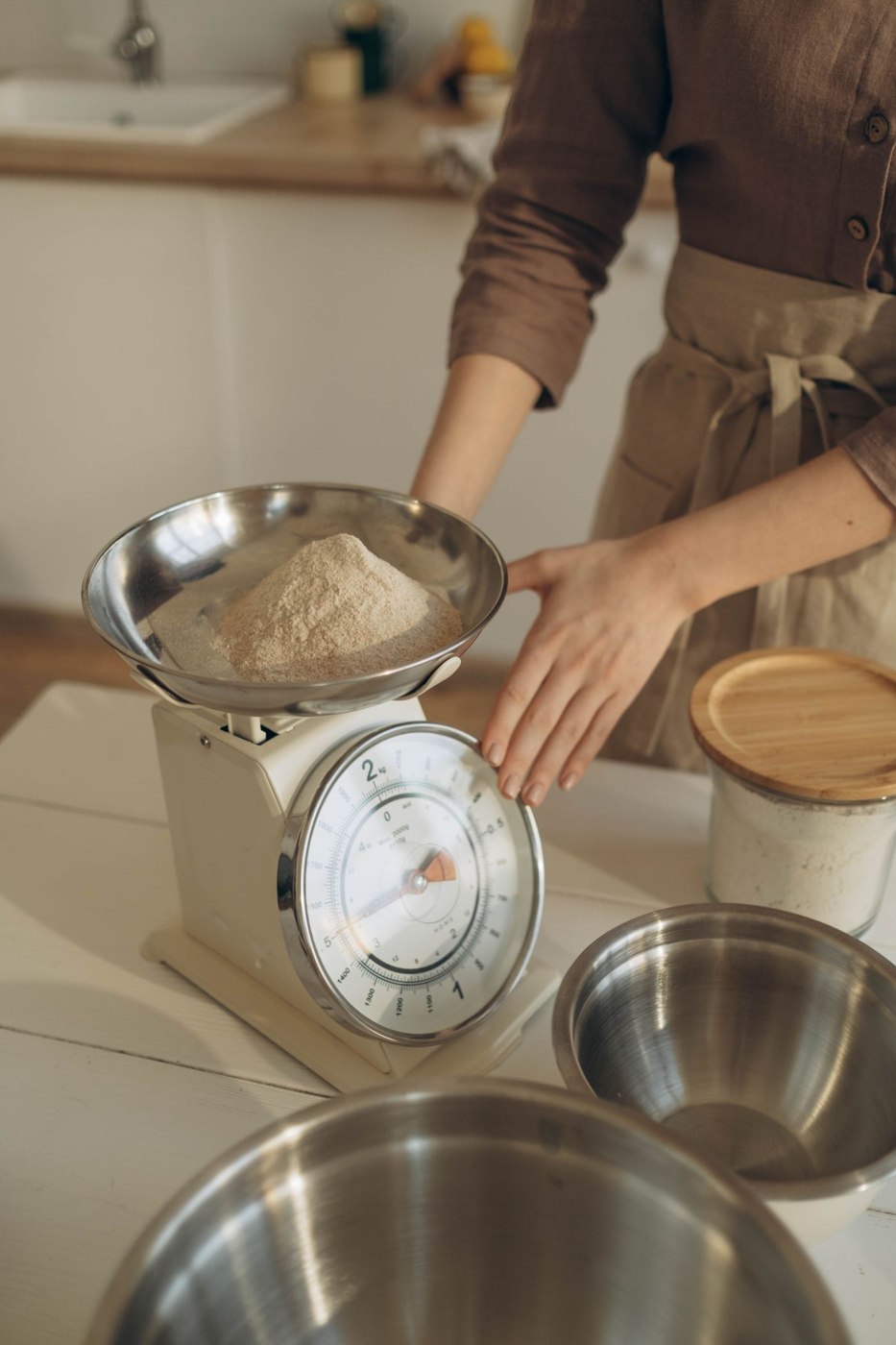
Place the scale on a stable level surface and use the correct unit. Set a suitable bowl on the platform, tare as instructed, and add the ingredient without leaning your hand or the bag against the bowl.
Check that the combined load stays within the scale’s capacity. Taring a bowl changes the display baseline; it does not make the bowl’s physical load disappear from the platform.
Wait for a stable reading before moving to the next ingredient. If you keep adding while the display is still changing, you can overshoot and then have to decide how to remove material from a mixed bowl.
For an ingredient that would be difficult to remove, a separate weighing vessel can be worth the extra dish. This is especially helpful when the next ingredient is small relative to what is already in the bowl.
Do not assume that a whole-gram display can resolve every tiny dose in a baking formula. Check the instrument’s documented increments and use an appropriate method for quantities near or below its useful range.
Convert deliberately when no weight is supplied
Find a reputable ingredient-specific chart and match the exact ingredient description. Whole nuts, chopped nuts, sifted flour, and packed brown sugar should not be treated as interchangeable forms because they share a broad ingredient name.
Keep the original volume amount and the chosen reference together in your notes. Then calculate the particular recipe quantity rather than replacing every cup with the same convenient number.
For example, if a reference assigns a mass to one cup of a particular ingredient, half a cup uses half that reference value. The arithmetic is straightforward, but it is only as appropriate as the ingredient and convention you selected.
Label the result as your conversion, and avoid unnecessary decimal precision. A long string of digits can make an uncertain reference look more exact than the underlying measurement deserves.
After baking, evaluate the finished result and the method together. One outcome cannot prove a universal conversion, but a clear record helps you repeat a version that works in your kitchen.
Keep comparisons useful rather than ideological
A good set of volume measures can be useful, especially when a recipe was developed with a clear volume method. A scale can reduce several sources of handling variation and simplify many weight-based recipes.
Neither tool automatically fixes a mistaken ingredient, an unsuitable substitution, or a recipe copied without its instructions. Accuracy starts with understanding what the author intended you to measure.
You can keep both kinds of tool and choose by the recipe. There is no need to convert a familiar successful family recipe merely to make the units look more technical.
When you share a converted version, explain the reference and method briefly. Another cook should be able to tell whether you weighed the ingredient yourself, followed a supplied weight, or calculated from a general chart.
Build a small set of reliable notes
Keep the recipes you make often with their actual measurement choices. Note the flour, the ingredient form, and any conversion you deliberately adopted, rather than maintaining a universal chart full of unsupported substitutions.
If you change a brand or preparation method, keep that change visible for the next batch. You may find the recipe remains forgiving, or you may notice a difference worth investigating.
Start with one recipe you know well and follow its supplied gram weights carefully. That gives you a useful comparison without asking you to relearn your entire baking routine at once.
The practical lesson is simple: cups and grams answer different questions. Match the ingredient, the recipe, and the measuring tool, and you will make fewer assumptions before the oven even heats.
Sources & scope
Checked October 22, 2026. Exact source claims are separated from original planning exercises and examples.