Use Your Cookware / THE HANDBOOK
How to Tell Whether Your Pan Will Work on Induction
Practical guidance · Check your own equipment, recipe and care instructions.
To check whether a pan will work on induction, look for the maker’s compatibility statement and test the cool base with a magnet. Then compare the base with your cooktop’s actual cookware and cooking-zone requirements, because magnetic attraction alone does not answer every question about fit.
You are checking a complete pairing: a particular pan on a particular appliance. A stainless appearance, a familiar brand, or a broad rim measurement is not enough to establish that pairing.
Start with the exact pan identity
Look underneath the clean, cool pan for a maker, model number, collection name, or induction symbol. Photograph those details for your own reference before you search a manufacturer’s current product page or contact support.
A brand can sell different collections with different materials, and a collection can change across generations. Do not transfer a statement about today’s version to an older unidentified pan without checking the connection.
An induction symbol is useful evidence when it belongs to the actual cookware. If you are shopping online, make sure the photograph and specification describe the selected size and model rather than an unrelated item in a carousel.
Keep your notes simple: exact identity known, maker says induction compatible, or identity unresolved. An honest unresolved note saves you from turning an uncertain image into a confident compatibility claim.
Understand what the magnet tells you
Induction requires suitable magnetic material in the cookware base. Bosch’s cookware guidance identifies cast iron, steel, and magnetic stainless steel as relevant materials, while ordinary aluminum, glass, and copper need a suitable magnetic layer to work in this context.
That means you cannot decide by the material name alone. A pan with an aluminum body may include a magnetic base, and the word stainless does not guarantee that every part of every pan behaves the same way.
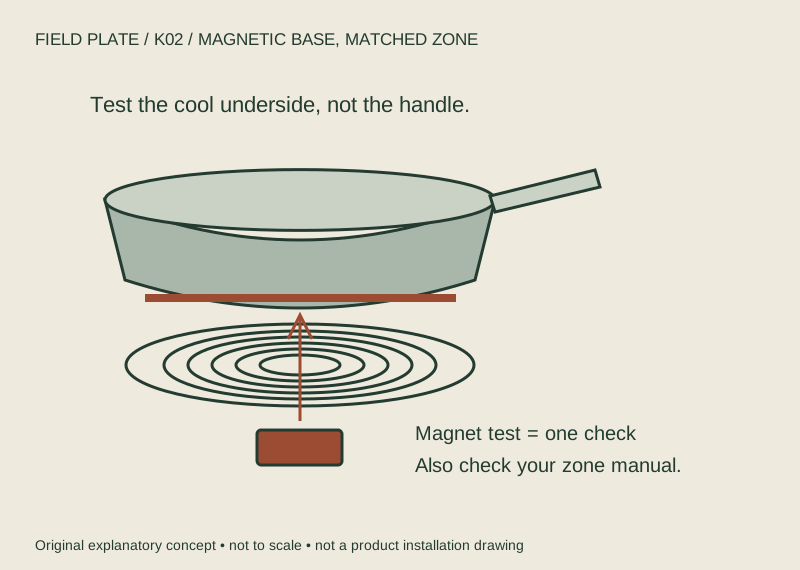
Place a household magnet against the underside of a cool, empty pan on a stable surface. Check the base that sits over the cooking zone rather than testing only a handle, rim, or lid.
Keep the magnet away from the appliance controls and any items that its manufacturer says could be affected by magnets. This is a simple cookware check, not a reason to place loose objects on a powered cooking surface.
If the magnet does not attach to the base, do not expect appearance or a seller’s vague description to overcome that result. Look for a clear manufacturer explanation before planning to use the pan on induction.
Check the base area, not just the top width
Your skillet may be labeled 12 inches across the opening while its underside contact area is much smaller. The cooking zone responds to the suitable base, so the opening diameter should not stand in for the measurement your manual requests.
Use the appliance instructions to identify the relevant dimension and measuring method. Some guidance refers to the cookware base, while a product listing may primarily advertise the rim or total body width.
Measure the cool base across the center and note the shape of the magnetic area if a separate disc is visible. Do not assume a decorative-looking circle is the exact active area unless the maker identifies it that way.
If the manual gives a minimum or maximum for a zone, keep that requirement tied to the specific zone. A number copied from a different cooktop model is not a useful substitute, even if the two appliances look similar.
This is also why a small saucepan can behave differently from a larger pan from the same set. The materials may be compatible while the smaller base falls outside the intended pairing for one zone.
Look at flatness and condition
Place the clean pan on a stable flat surface and check whether it sits as intended. A pan that rocks, has a damaged base, or has accumulated material underneath deserves attention before you evaluate cooking behavior.
Do not grind, hammer, or bend a base to make an induction experiment work. Ask the cookware maker about damage and check the appliance manual’s requirements for contact and condition.
Keep both the underside and the cooktop clean according to their respective instructions. Debris between them is a separate issue from magnetic compatibility and can create an avoidable surface-care problem.
Lift the pan rather than dragging it across a glass cooking surface when the instructions call for that handling. Cast iron may be compatible, but compatibility does not cancel the need for careful movement.
Try a normal supported cooking task
Once the maker’s compatibility statement, the magnet check, and the appliance requirements agree, follow the cooktop manual for a normal first use. Use the correct cooking zone and center the pan as directed.
Do not begin by running an empty pan at maximum power to see how fast it heats. That tells you little about a useful daily routine and can conflict with the cookware’s instructions.
Stay present and use the food or liquid and method appropriate to your pan. Keep handles safely positioned and remember that a compatible pan can become very hot during ordinary cooking.
If the appliance displays a cookware-detection message, read the exact message in its manual. A flashing display may relate to placement, size, settings, or another condition; it is not automatically proof that every pan in the set is unsuitable.
Stop if the instructions direct you to stop or if you notice damage or unusual behavior. A controlled check should reduce uncertainty, not turn into repeated unsupported attempts at higher power.
Troubleshoot the pairing in a useful order
First confirm that the zone is selected and the pan is centered as the manual describes. Then recheck the base dimension and exact cookware identity before you conclude that the appliance has failed.
If another known compatible pan works on that zone, record the difference without turning it into a complete diagnosis. You have learned that one pairing behaves differently, which is useful information for customer support.
Provide support with the cooktop model, pan model, base measurement, selected zone, and exact display message. Those details are more actionable than saying that a metal pan will not work.
Avoid buying an adapter plate as an automatic fix. It introduces another component with its own compatibility, loading, temperature, and care requirements, and it may not be approved for your appliance.
Likewise, do not assume a portable induction unit follows the same limits as your built-in cooktop. Check each appliance’s own instructions when you move cookware between them.
Make a compatibility note for the kitchen
Once you have established a working pairing, write a small private note listing the pan, the suitable zone, and any relevant use restriction. That can save another household member from repeating the investigation.
Keep the note focused on the exact equipment rather than writing that all stainless or all cast iron works everywhere. Material categories are helpful starting points, but actual models and dimensions make the answer useful.
When you replace a pan, repeat the check for the new item rather than relying on the old pan’s label. Similar advertised diameters can hide a different base construction or footprint.
When you replace the cooktop, revisit the appliance side of the pairing too. You may keep much of your cookware, but the right way to establish that is through matching evidence and the new instructions.
You can often finish this check with information you already have and a simple magnet. The valuable result is a clear, supported answer for your own pan and stove, not a larger shopping list.
If you lend a pan to someone with a different appliance, share the maker’s information rather than only your own successful result. Their cooktop may have different detection requirements, and a clear model label lets them check the pairing without repeating guesses about the material.
Sources & scope
Checked October 22, 2026. Exact source claims are separated from original planning exercises and examples.