Best Picks & Buying Guides / THE HANDBOOK
Best Compact Kitchen Scales for Weighing Ingredients in a Small Bowl
Research comparison · No hands-on testing claimed.
For a small mixing bowl and a simple tare-and-add routine, start with the Escali Primo in Chrome; choose the OXO Good Grips 11-pound pull-out-display scale when your bowl tends to hide the numbers. The useful difference is how each design fits your weighing setup, not a laboratory accuracy ranking.
This is a research comparison of two specific Amazon listings, supported by manufacturer information where available. We have not calibrated these units, timed their displays, or tested how they behave after a spill, so those outcomes are not part of the recommendation.
Decide where the bowl and your eyes will go
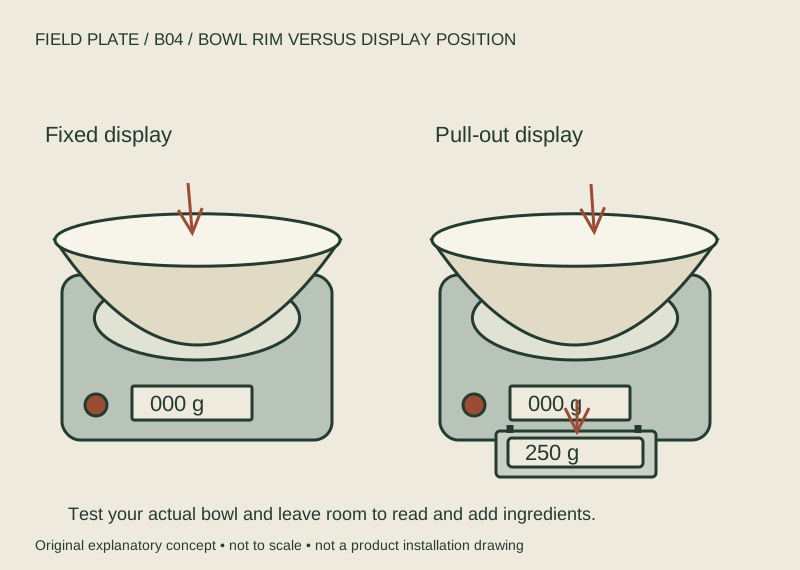
Set your usual empty bowl on the counter and imagine a scale underneath it. Notice how far the rim projects toward you and where you would need the display to sit to read it comfortably.
A small bowl can leave a fixed display completely visible. A wide plate or deep bowl with a flared rim may create a different problem even if its base fits comfortably on the platform.
Measure the space where you will operate the scale, not just the drawer where you hope to store it. Include room to add ingredients without knocking the bowl into a backsplash or pressing against another appliance.
Check the complete physical load, including the bowl, against the scale’s rated capacity. Taring changes the reading’s reference point; it does not remove the container’s weight from the load the instrument supports.
We kept this shortlist to two documented designs with different display arrangements. More colors or near-identical listings would add shopping choices without improving the central decision for a small-bowl workflow.

Escali Primo: the simpler starting point
The Chrome Primo listing identifies an 11-pound capacity, gram-based weighing, tare, and two-button operation. Its straightforward control arrangement makes it the first model to consider when you want an uncomplicated sequence of container, zero, and ingredient.

Choose it when your usual bowl leaves the display visible and you prefer a fixed arrangement with few controls. The model’s compact-looking form does not replace checking its actual footprint against your storage and working space.
Its strength here is the clarity of the proposed task, not a claim that fewer buttons produce more accurate measurements. You still need a suitable level surface, an appropriate load, and time for the display to settle.
The listed automatic shutoff is relevant if you pause to find ingredients between additions. Read the current instructions and keep your own recorded amounts rather than depending on an unfinished sequence remaining on screen indefinitely.
The compromise is display placement: it remains in the body rather than moving toward you beneath a large bowl. If your current problem is an obscured reading, buying another fixed-display scale may leave that particular frustration unresolved.
Do not treat the button area as evidence that the entire scale is waterproof. Escali’s care information distinguishes ordinary cleaning from immersion, which is a useful limit to remember near flour, batter, and a busy sink.
OXO pull-out display: for a bowl that hides the reading
The exact OXO Amazon listing describes an 11-pound scale with a display that pulls forward. That feature is the reason to consider this design when the bowl you actually use blocks a fixed readout.

Choose it when visibility under a projecting rim is the practical obstacle you want to solve. The extra reach can give you another display position without requiring you to lift the bowl every time you check an addition.
That is a design-based recommendation rather than a measured claim about viewing angles. We have not compared glare, text contrast, response time, or visibility for every bowl shape, so check the arrangement you need before buying.
The listing also describes tare and unit conversion, keeping the basic weighing sequence familiar. Select the unit required by your recipe before adding food instead of converting an unexplained number after the bowl is full.
The tradeoff is that a moving display needs operating room in front of the body and an appropriate storage position afterward. A drawer that fits the retracted unit may not represent the space you need while cooking.
Follow the exact model’s cleaning directions for its platform and body. A removable component can simplify access, but it does not establish that electronics or every attached part can go into water or a dishwasher.
Compare the routine rather than counting features
Run through a pretend recipe before choosing: place a bowl, tare, add flour, record the amount, then tare again for the next ingredient. Ask which design makes that sequence easiest in your actual counter space.
For the Primo, the main check is whether the fixed display remains readable with the bowl in position. For the OXO, confirm that pulling out the display gives you a useful view without reaching into an awkward or crowded area.
Both listings describe household kitchen scales with gram readings, but that does not establish laboratory equivalence. Displayed increment, repeatability, calibration, and accuracy are separate concepts that this research comparison has not measured.
Neither should be chosen as a specialist instrument for very small quantities merely because grams appear on the screen. Match the required precision to a documented capability instead of assuming a kitchen scale covers every measurement task.
If you mainly weigh small bowls and the numbers are already easy to see, the pull-out mechanism may solve a problem you do not have. If you repeatedly lift a large bowl to read a fixed scale, that feature deserves more weight than cosmetic preferences.
Keep unit choices understandable
Use the mass unit stated in the recipe when it is provided. Avoid turning a gram amount into cups and then weighing again, because the extra conversion can introduce an ingredient or rounding mismatch.
When a recipe gives only volume, use a relevant ingredient-specific reference if you choose to convert it. One cup of flour does not have the same mass as one cup of every other pantry ingredient.
Check which modes the exact listing and manual provide before buying for a particular task. A mode label should be understood from the instructions rather than interpreted as universal permission to measure any liquid by volume.
Keep written quantities during a long mixing sequence, especially before pressing tare again. Once you reset the reference, a clear note is more dependable than trying to remember the previous display after an interruption.
Check the exact listing before checkout
The links here lead to the specific Amazon products discussed, not a search page or a multi-model roundup. Recheck the title, selected color, package contents, and seller because marketplace offers can change.
For the Primo, this comparison uses the Chrome listing rather than assuming all colors or bundles include the same extras. For the OXO, the relevant design is the 11-pound pull-out-display listing shown here.
Do not buy based on an accessory visible only in a lifestyle photograph unless the listing says it is included. A bowl, measuring spoon, or background prop may demonstrate use without being part of the package.
Prices and availability vary, so compare the current offers after deciding which design fits your task. A small price difference does not make an obscured display easier to read or create missing counter space.
Make the scale earn its place
Before its first recipe, practice tare and unit selection with an empty bowl and a safe, dry ingredient. That gives you a clear understanding of the controls without a time-sensitive pour already underway.
Store it as directed, with the platform protected from unnecessary pressure and the body away from excluded heat or moisture. Keep the operating space level and clear when you bring it out again.
Choose the Primo for a visible small-bowl setup and a simple routine; choose the OXO when moving the display addresses a specific visibility problem. Either choice works best when the physical arrangement, the recipe unit, and the scale’s documented limits are clear before you begin.
Sources & scope
Checked October 22, 2026. Exact source claims are separated from original planning exercises and examples.
- support.kitchensupply.com — Primo tare/unit control workflow, capacity and auto-off checks remain exact model instructions.
- support.kitchensupply.com — Primo body cleaning and non-immersion limitation; no waterproof claim.
- www.oxo.com — Pull-out display design as a visibility choice, not a calibrated performance comparison.
- www.amazon.com — Exact Chrome Primo listing capacity, controls, unit and auto-off information.
- www.amazon.com — Exact OXO pull-out display listing, tare and unit conversion; no unverified SKU or newer model substitution.