Best Countertop Drinking Water Filtration Systems for Clean Tap Water
Discover countertop filtration options that fit standard kitchen taps, reduce common contaminants, and require minimal installation. This guide highlights five top picks, who they’re best for, and practical buying considerations to help you choose confidently.
| Product | Best For | Why It Stands Out |
|---|---|---|
| Waterdrop CTF-01 | Households needing durable stainless steel design | Stylish, corrosion-resistant finish with mineral-infused filtration |
| DREO 7‑in‑1 RO Countertop | Homes seeking advanced contaminant removal | Real-time TDS monitoring and auto-fill for convenience |
| iSpring CKC1C | Budget-conscious filter upgrades | Clear housing and easy setup with standard faucet compatibility |
| Waterdrop M6HG | Hot or room-temp RO water fans | Mineral-infused RO with hot water option |
| DREO RO Countertop (2 pitchers) | High-volume or multi-user households | Two autofill pitchers and strong contaminant reduction |
Waterdrop CTF-01 Water Filter for Sink Faucet

The Waterdrop CTF-01 is a stainless steel countertop faucet filter designed for standard taps. It reduces heavy metals and chlorine while preserving essential minerals. It does not reduce total dissolved solids (TDS), so clear expectations are important for mineral-rich water. It’s best for households that want a durable, visually appealing unit with straightforward installation and a switch to toggle between filtered and tap water.
- Best for: Homes needing a robust stainless-steel unit compatible with standard faucets
- Why selected: Durable construction and simple faucet integration
- Limitation: Not compatible with pull-out, handheld, spray-style, or sensor faucets
DREO 7‑in‑1 Countertop RO Water Filter

This countertop RO system emphasizes comprehensive contaminant removal with real-time TDS monitoring and filter-life reminders. It features auto-fill and self-cleaning capabilities to minimize maintenance. The device targets a broad range of pollutants, including PFAS, chlorine, and fluoride, making it a solid choice for households prioritizing advanced purification and convenience.
- Best for: Those who want 99.9% contaminant reduction with real-time TDS feedback
- Why selected: SGS-tested to NSF/ANSI 58 standards with practical maintenance reminders
- Limitation: RO systems generally waste some water during filtration processes
iSpring CKC1C Chlorine Removal Countertop
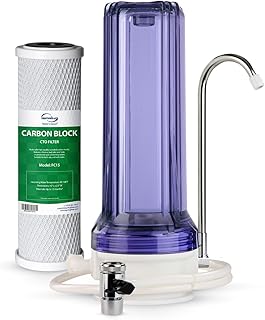
The iSpring CKC1C offers a transparent housing so users can see filter life at a glance, with a 5-micron carbon block cartridge that removes about 95% of chlorine and odors. It’s a straightforward, no-drill installation that connects to most standard taps, making it a practical upgrade for improving taste and smell without a heavy investment.
- Best for: Buyers who want visibility into filter status and a quick upgrade
- Why selected: Clear housing helps you monitor changes easily
- Limitation: Removes chlorine effectively but may not address the widest contaminant range
Waterdrop M6HG Instant Hot Countertop RO Water Filter

The Waterdrop M6HG combines an 8-stage RO filtration system with mineral infusion to balance taste, and it offers hot and room-temperature water. It’s NSF/ANSI 58 certified, with a focus on lead-free materials and a mineral-enhanced finish. This model suits households that want hot purified water without a separate appliance, along with the health assurance of established standards.
- Best for: People who want hot water from a countertop RO system
- Why selected: Mineral-infused RO to improve flavor while providing hot options
- Limitation: More complex setup and higher initial cost than basic countertop filters
DREO Countertop RO with 2 Autofill Pitchers

This DREO model emphasizes high-volume use with two autofill pitchers for continuous access to clean water. It reduces a broad spectrum of contaminants, including PFAS and fluoride. It’s well-suited for multi-user households or spaces where multiple pitchers are convenient for daily water needs.
- Best for: Households needing higher water throughput and convenient autofill
- Why selected: Dual pitchers support multi-user demand
- Limitation: Additional space required for two pitchers on the countertop
Buying Guide: Key Considerations for Countertop Drinking Water Filtration
What should you evaluate when choosing a countertop filtration system?
- Contaminant focus: Identify the pollutants you want to reduce (chlorine, PFAS, heavy metals, fluoride, etc.). Some systems emphasize taste and odor, while others target a broader contaminant range.
- Filtration technology: Activated carbon, reverse osmosis, multi-stage filters, and mineral infusion each have strengths. RO systems typically deliver deeper purification but may waste more water and require more maintenance.
- Flow rate and capacity: Consider daily water needs and whether a countertop unit provides sufficient filtered water without frequent cartridge changes.
- Faucet compatibility: Some filters only fit standard faucets; if you have special faucet types (pull-out, spray, sensor), confirm compatibility before purchase.
- Materials and build: Stainless steel finishes resist fingerprinting and corrosion, while clear housings help you see filter status at a glance.
- Maintenance and reminders: Look for real-time TDS monitoring, filter-change alerts, or auto-clean features that simplify upkeep.
- Electrical or non-electrical: Some RO systems include auto-fill or hot-water options that rely on electricity or sensors; ensure you can safely install them in your kitchen.
Frequently Asked Questions
- What does a countertop water filter typically remove?
- Can countertop RO systems waste water?
- Is installing a countertop filter difficult?
- Which features improve convenience and reliability?
- Do filters affect water’s mineral content?
- How often should I replace the filter cartridges?
Answer summaries: Countertop filters commonly reduce chlorine, sediments, and odors; RO systems remove a broader array of contaminants but may require more water and maintenance. Installation is usually quick with standard taps, though some units need more space or electrical access. Look for real-time monitoring, auto-fill, and clear housings to enhance reliability. Mineral-infused options preserve beneficial minerals while improving taste, but verify that this aligns with your hydration goals. Replacement intervals depend on usage and water quality; follow manufacturer guidance for cartridge life.